
Why the water-source question matters here
Boerne Utilities identifies lake and well sources in its supply mix and says hardness varies within the system. Its guidance supports an address-specific question, not a single number to assign to every home. Irrigation may also use a different source from the indoor tap. Share what you know from your property records, and mark the source unknown when you cannot confirm it.
Water information provides context for a deposit assessment. It does not establish why one pane is cloudy or whether a particular mark is removable. A glass cleaner still needs to consider the surface, coating and actual condition. A provider who asks about the affected exposure is answering a more relevant question than one who treats the city name as a diagnosis.
Make a spot map by exposure
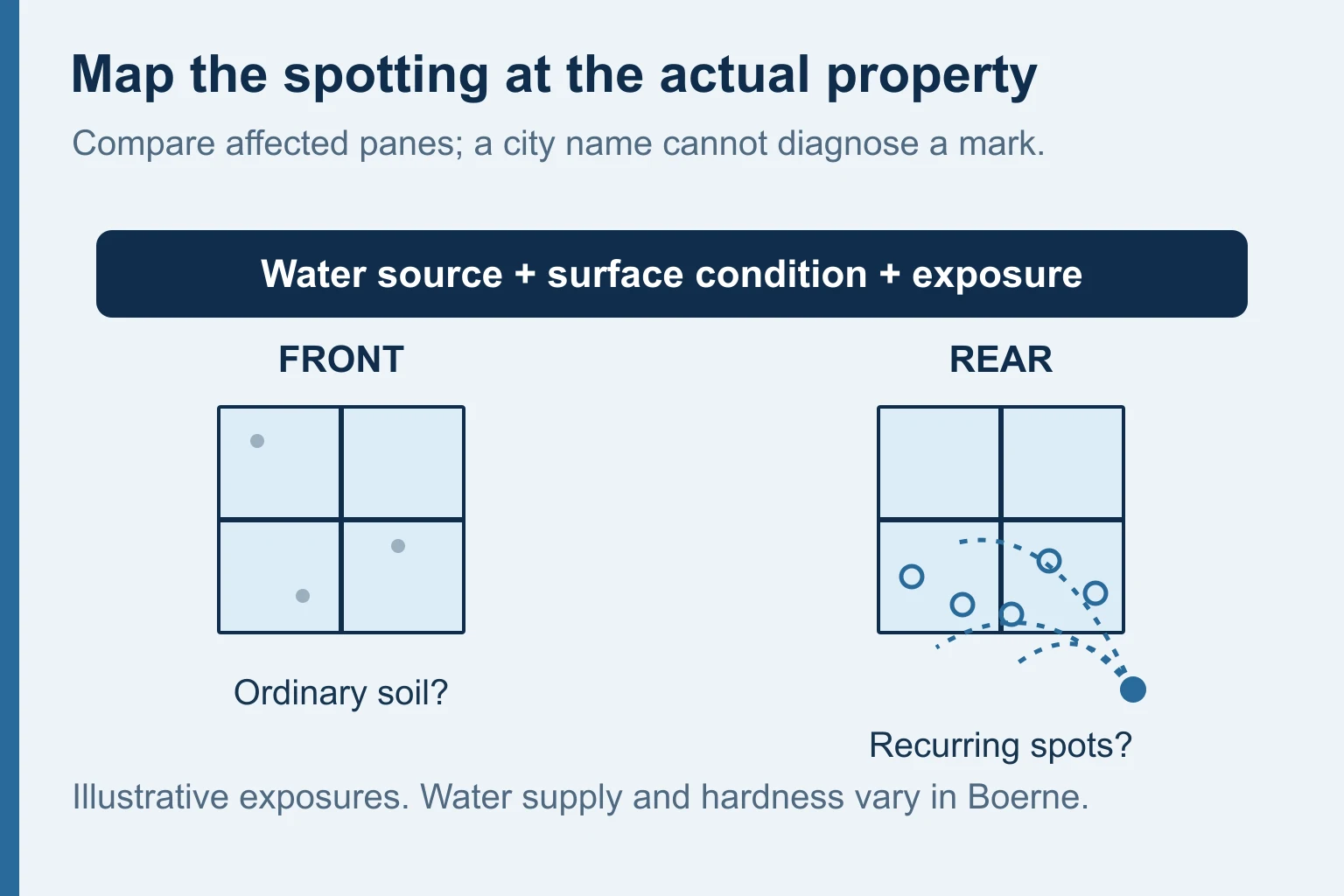
Label front, rear and side elevations on ground-level photographs. Mark which panes show spots and whether irrigation reaches them. Add a dry close-up of a typical mark and one comparison pane that looks different. Include the screen position where it affects the view. You do not need to run a water test or reach high glass to prepare a useful request.
- Pattern: scattered droplets, a lower band, a streak or more general clouding.
- Location: the named facade, room or door and the apparent side affected.
- History: when you first noticed it and whether ordinary washing changed it.
- Surface information: any known film, coating, prior treatment or existing damage.
Compare targeted assessment with whole-property treatment
Imagine a home whose rear panes spot after irrigation while the front primarily collects ordinary dust. Request routine cleaning for the selected glass, with the affected rear panes identified for assessment. A blanket request to remove hard-water stains everywhere might expand the work beyond the observed problem. A routine-only request might overlook the concern that motivated the call.
Ask each bidder what it would learn from a representative test and how it would describe a partial improvement. The NGA/IWCA guidance emphasizes glass identification and manufacturer instructions before method selection. A test should help decide whether to proceed, accept a remaining condition or seek a different glass assessment. It should not be treated as a universal guarantee for every pane.
Confirm that the route includes the exact property
Texas Window Washing published a Boerne service page in the October 30, 2026 source review. That makes it a company to ask, not a confirmed appointment for every outlying address. Provide the location directly and compare any travel, minimum-charge or timing terms each candidate specifies. Keep those terms alongside the actual cleaning scope rather than assuming all Boerne routes operate alike.
Show access separately from spotting. A rear window above a slope, a courtyard gate or a screen that cannot readily be removed can change the work even when the deposit itself is familiar. Wide photos reveal those constraints better than a close-up alone. Ask the provider to identify any requested pane it cannot include through the proposed method.
Use the first result to improve the next decision
After cleaning, retain the labeled photos of assessed panes and note which marks cleared or remained. If spotting returns, note when and where before assuming the earlier wash failed. A new irrigation deposit and a persistent original condition are different follow-up questions. Addressing spray contact may require an irrigation provider rather than another glass treatment.
Choose the cleaner whose response addresses the map, the relevant surfaces and the route. This is an address-level comparison, not a best-company ranking. It lets a routine wash stay routine while giving the few genuinely uncertain panes the attention they need.
Sources and further reading
Bring the spot map to a Boerne inquiry
Review the local service page, then provide the address and affected glass so scope and availability can be discussed.
See Boerne cleaning options